

Blog

blog

Blog

blog

Blog

blog

How to Choose an Outdoor Giant Pole Flag Banner

Choosing an Outdoor Giant Pole Flag Banner is not just a matter of picking the largest design. The right banner should suit its location, pole, viewing distance, and typical weather. A broad flag may catch attention across a parking area, yet it can also place more strain on its support. Check the pole’s recommended banner size before ordering. Small details matter.

Fabric and construction affect how a banner looks and performs outdoors. Compare fabric weight, reinforced edges, stitching, and the attachment method, such as sleeves or grommets. Ask how the printed design handles sunlight and repeated exposure to rain. No material stays pristine forever. Still, clear care instructions and realistic product specifications can help you make a more informed choice. If possible, inspect a sample or request close-up photos of seams and print quality.

Think about the site itself. Measure the available space, note nearby trees or buildings, and consider whether people will view the banner from a road, walkway, or event area. A design that reads well up close may lose clarity from across a wide lot. Keep text brief and contrast strong. This sounds obvious, but crowded layouts are easy to approve on a screen. Before buying, confirm dimensions, pole compatibility, installation needs, and replacement options with the supplier. A little checking now may prevent a banner that looks impressive in a catalog but feels wrong once raised.
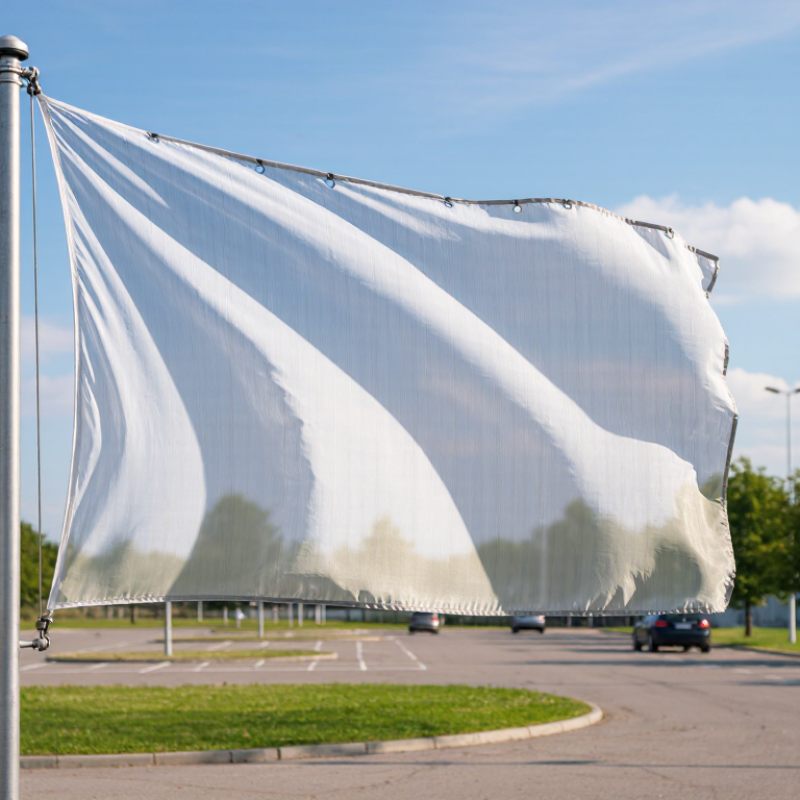
How to Choose an Outdoor Giant Pole Flag Banner

Map Site Wind Exposure Using ASCE 7 Basic Wind-Speed Data

How to Choose an Outdoor Giant Pole Flag Banner

Map Site Wind Exposure Using ASCE 7 Basic Wind-Speed Data

Start with the map. Before choosing a giant pole flag banner, locate the project site in the ASCE 7-22 basic wind-speed data. The mapped value represents a three-second gust at 33 feet above ground. For Risk Category II structures, ASCE 7-22 uses a 700-year mean recurrence interval, equal to a 0.2% annual probability. This number is a design starting point, not a safe operating limit.

Then inspect the site. Exposure B usually describes urban or suburban areas with closely spaced obstructions. Exposure C fits open terrain, farmland, and long stretches near highways. Exposure D applies to flat, unobstructed areas near large bodies of water. A coastal parking lot may look developed, yet its wind exposure can remain severe. I once treated a sheltered-looking entrance as Exposure B; the surrounding open pavement made that assumption unreliable.

Check topography, pole height, banner area, and hardware together. ASCE 7-22 considers directional effects, gust response, and pressure coefficients during design. FEMA guidance also stresses that windborne damage often begins at weak connections, not the fabric itself. Ask an engineer to verify the pole foundation, sleeve, fasteners, and banner release system. The map is useful. It is not enough. A practical site survey should record nearby buildings, tree lines, slopes, drainage channels, and seasonal wind changes before installation.

Match Banner Size and Pole Height to Rated Wind-Load Limits

How to Choose an Outdoor Giant Pole Flag Banner

Match Banner Size and Pole Height to Rated Wind-Load Limits

A giant pole flag must suit its pole, foundation, and local wind conditions. A larger banner catches more air and creates stronger sideways force. The pole may look sturdy, yet its base can still fail under repeated gusts. Check the supplier’s rated wind-load data before selecting fabric or dimensions. Do not rely on appearance alone.

Start with the site, not the artwork. Open fields, rooftops, and coastal areas usually experience stronger airflow. Nearby buildings can create sudden turbulence. Measure the proposed banner width, height, and total surface area. Then compare those figures with the pole’s approved load range. The banner height should not exceed the pole’s tested limit. A taller pole is not automatically safer.

Small details matter. Use the recommended anchor depth, base hardware, and attachment points. Inspect bolts, seams, and ground movement after storms. If the banner flaps violently, remove it before damage spreads. Temporary wind limits need clear instructions for staff. A weather app may show average wind, but gusts cause many failures. That distinction is easy to miss.

I have seen installations focus on visibility while ignoring wind exposure. That approach feels practical, but it can become expensive. Rated limits are not optional suggestions. When site conditions seem uncertain, ask a qualified structural professional to review the setup. Conservative sizing may reduce visual impact slightly. It can also protect people, property, and the banner itself.

Compare 110–150 g/m² Polyester and UV Colorfastness (ISO 105-B02)

How to Choose an Outdoor Giant Pole Flag Banner

For a giant pole flag, polyester weight affects movement, visibility, and service life. A 110 g/m² fabric is light and flies easily in moderate wind. It can create a bright, flowing display, but may feel less opaque against strong sunlight. A 150 g/m² fabric offers a denser appearance and better print coverage. However, it adds weight and may place more strain on the pole and stitching. Heavier is not always better. I once preferred a thicker flag, but its movement looked noticeably slower in light wind.

UV colorfastness deserves equal attention. ISO 105-B02 evaluates resistance to artificial light, commonly using a xenon arc test. Results are compared with a blue wool reference scale from 1 to 8. Higher ratings indicate better resistance, but test conditions still matter. Ask for the actual report, rating, exposure duration, and tested material. A printed fabric may perform differently from an unprinted sample. Sunlight, moisture, pollution, and frequent washing can also accelerate fading.

Tips: Match 110 g/m² polyester with temporary campaigns or sheltered locations. Choose 150 g/m² when stronger opacity and a more substantial appearance are important. Check pole load limits before ordering. Request a colorfastness rating suitable for your climate, not just a general “UV resistant” claim. Inspect seams, hems, and fixing points too. Color can remain strong while stitching fails first.

Select Fabric Using Air-Permeability Testing (ASTM D737)

Choosing an outdoor giant pole flag banner begins with fabric, not color. Large banners face steady wind, sudden gusts, and repeated folding. Air permeability helps reveal how easily air passes through the cloth.

Ask for an ASTM D737 test report from the fabric supplier. This method measures airflow through a defined fabric area under controlled pressure. Results may appear as cubic feet per minute per square foot or similar units. Higher permeability usually reduces wind pressure on a large banner. It can also reduce visual density.

Do not treat one number as a complete decision. Test pressure, fabric finish, moisture, and construction can affect the result. Compare samples tested under the same conditions. A tightly woven polyester may look crisp but catch more wind. An open mesh fabric may breathe better, though small text can become less readable. We learned this the hard way on a tall roadside banner; the artwork looked sharp indoors, then weakened at viewing distance.

Inspect seams, hems, grommets, and pole sleeves with the fabric. They carry real stress. A breathable panel can still fail when its edges are poorly reinforced. Local wind exposure matters too. Coastal air, open fields, and narrow urban corridors create different demands. ASTM D737 is useful evidence, not a weather forecast. Select a fabric that balances airflow, image clarity, durability, and maintenance. Leave room for doubt. Conditions rarely match the laboratory perfectly.

Choose Pole, Base, and Anchors for the Site’s Ground Conditions

Choosing an outdoor giant pole flag starts with the ground, not the banner. On installation visits, I check soil firmness, drainage, slope, and nearby underground services. A tall flag creates strong leverage during gusts. Soft soil may need a deeper footing or a wider engineered base. Firm concrete can support a sleeve, but cracked concrete needs inspection. Do not guess from appearance. A site survey often reveals hidden risks.

For grass and compacted soil, use a buried foundation sized for pole height and local wind exposure. Wet clay shifts after rain, so drainage and concrete curing matter. Loose sand often needs a larger footing, deeper anchoring, or a weighted temporary base. On asphalt, surface-mounted plates require verified load capacity and suitable fasteners. They are not interchangeable. A heavy base may work on level pavement, but it can become unstable on slopes.

Select the pole’s material and diameter according to banner area, height, and wind rating. Appearance alone is not enough. Hinged or sectional poles can simplify maintenance, but their joints need regular checks. Use ground anchors where the soil provides reliable grip. For exposed sites, add guy lines only when pedestrian clearance remains safe. Check anchor tension after storms. I once underestimated how quickly wet ground could loosen a temporary base. That mistake changed my inspection routine. Local wind data and an engineer’s review are worthwhile for very large installations.